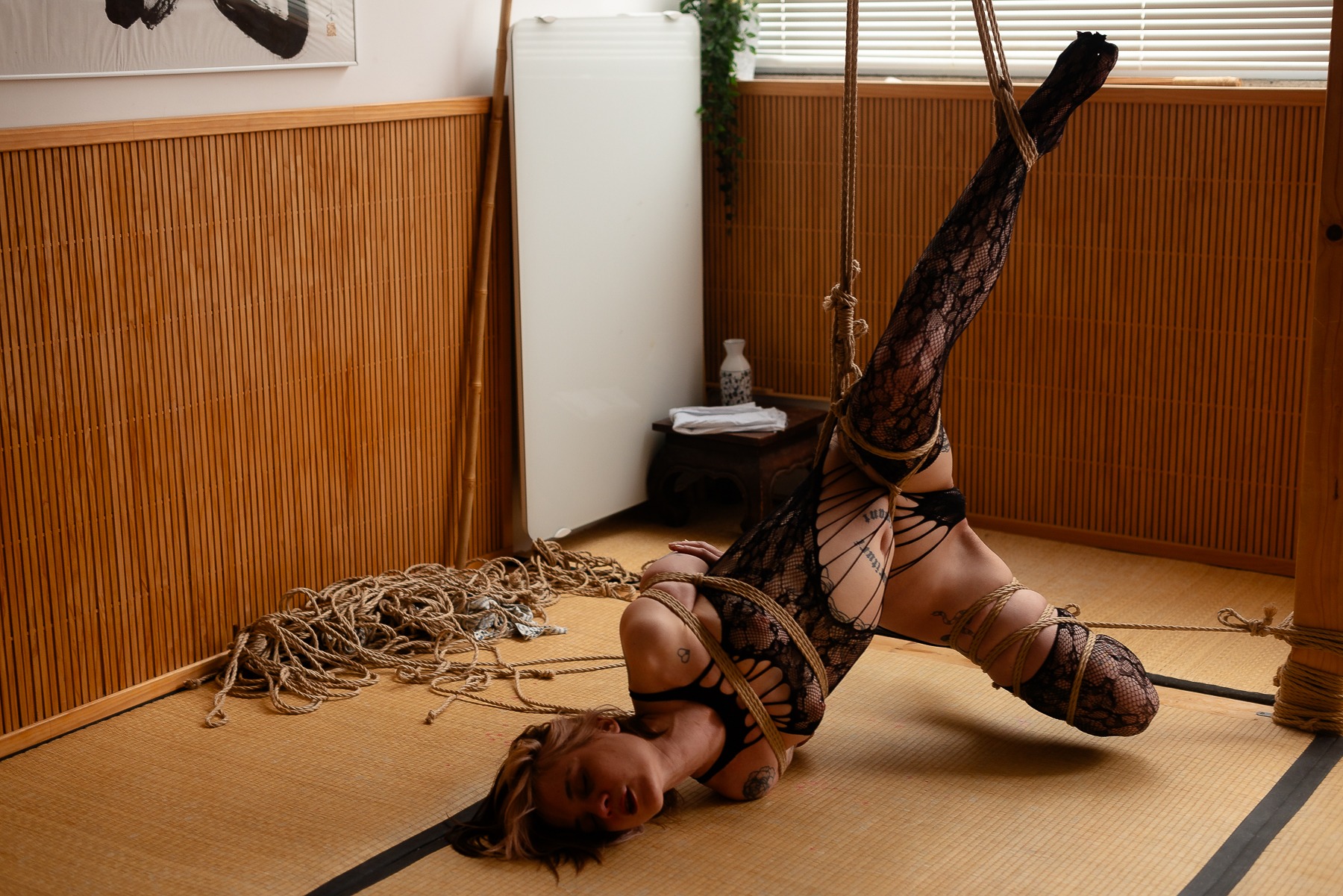


Comment bien choisir et entretenir ses cordes de shibari ?
A l’origine, le kinbaku était une technique appelée Hojojutsu . Elle consistait à ligoter les prisonniers selon leur rang, leur faute. Les cordes de shibari utilisées étaient souvent des cordes de riz. On attachait beaucoup par l’arrière afin de ne pas montrer la manière d’attacher, de telle sorte que la libération était quasi impossible. Certains policiers, encore de nos jours utilisent les cordes au japon.
Caractéristiques des cordes de bondage
Les cordes de shibari généralement utilisées sont en jute de 6mm de diamètre. Toutefois, pratiquer avec des cordes en chanvre de 8mm était courant en France il y a encore quelques années. Attention, néanmoins, descendre en dessous de 4mm est dangereux, la solidité et la résistance des cordes de shibari sont réduites, et le bondage risque d’être difficile à dénouer.
La longueur des cordes de shibari en Europe est de 8m; contre 7m au japon, les asiatiques étant réputées plus « fines » physiquement. Mais certains Maîtres comme Kinoko Hajime n’hésitent pas à utiliser des cordes de bondage de différentes longueurs.
Le choix de la matière est lui aussi très important afin de ne pas se blesser. Une matière telle que le nylon est à éviter car elle brûle la peau. Le lin peut servir pour le kinbaku, mais est très cher et pratiquement introuvable.
Les cordes brutes en jute peuvent être utilisées mais elles doivent être préalablement brûlées à la flamme, puis waxées (cire d’abeille).
Bien entretenir ses cordes de shibari
Il existe plusieurs façons d’entretenir ses cordes de bondage :
1 – brûler, essuyer avec un chiffon humide pour retirer la pellicule de suie qui recouvre la corde de shibari, sécher environ 6h pour ne pas laisser l’humidité pénétrer dans la corde (une humidité interne risquerait de faire moisir la fibre notamment si on les renferme dans un sac dans la foulée.), waxer la corde, sécher environ 12h, puis essuyer avec un chiffon doux. => résultat : corde traitée qui conserve une couleur très claire, surtout valable avec la jute blanche.
2 – brûler, waxer dans la foulée, sécher 12h, essuyer avec un chiffon humide, puis sécher 6h => résultat : une corde de bondage traitée qui va foncer un peu dans les tons gris.
3 – waxer, sécher 12h, puis brûler pour que la wax s’imprègne, utilisation d’un chiffon doux et sec pour supprimer le surplus de wax et de suie. => résultat sensiblement identique au cas n°2.
Globalement toutes ces méthodes se valent. Il s’agit d’un choix personnel et il faut tester et trouver ce qui nous convient comme rendu final.
Nous préconisons cependant de ne jamais laver les cordes de shibari en jute. L’expérience au fil des ans prouve qu’elles perdent de la tension, difficile à récupérer.
Attention à bien faire sécher les cordes une fois waxées (environ 12 heures, afin que la wax imprègne la corde correctement). Il faut IMPERATIVEMENT essuyer les cordes après waxage, pour éliminer le surplus de wax. Sans quoi la corde est excessivement glissante et les nœuds peuvent glisser, notamment en suspension.
Nous insistons sur le fait qu’il ne faut pas utiliser les cordes de shibari immédiatement après waxage. Il est IMPERATIF de les essuyer après waxage et malgré tout de rester vigilant. Quand nous disons vigilant, c’est surtout pour les suspensions (prendre toutes les précautions possibles sur les verrouillages pendant une ou deux utilisations). Au sol, le danger est moindre.
Bien vérifier ses cordes de shibari
C’est sans aucun doute le plus important des actes avant une session. Une corde de bondage qui se casse peut arriver, et ceci même aux plus grands. Si on remarque un défaut dans la corde, celle-ci doit être mise de côté car un accident est trop vite arrivé par négligence de son matériel. Et n’oubliez jamais que la personne attachée vous a confié sa « vie ». Soyez en dignes.
Enfin pour éviter les erreurs, certains gestes sont très utiles afin de garantir une bonne pratique du kinbaku. Les « boutons » par exemple, sont les nœuds qui finissent les cordes de shibari, on peut aussi ligaturer au delà des boutons avec du fil de différentes couleurs pour reconnaître leur longueur. Certains n’utilisent pas de boutons mais ligaturent leurs cordes seulement. On peut aussi utiliser les deux techniques.
Prendre soin des cordes de shibari que vous venez d’acquérir
Prendre soin de ses cordes de bondage, c’est éliminer certains risques. Rappelons que le kinbaku, comme toutes pratiques SM peut apporter énormément de plaisirs et de sensations si quelques gestes simples au niveau de l’entretien du matériel sont respectés.
Il existe également beaucoup de façons de plier ses cordes, l’important étant de ne pas faire de nœuds, et de pouvoir facilement retrouver le milieu de la corde pour une certaine vitesse d’exécution et une perte de temps inutile.
Comme toutes fibres, la corde de shibari prend des « plis ». Imaginez un pull laissé en vrac dans un sac, plié pendant plusieurs jours, il finira par prendre la marque des plis. Nous préconisons donc que les cordes soient pendues pendant plusieurs jours. Elles reprendront leur forme naturelle plutôt que de traîner dans un sac ou un furoshiki.
L’achat de cordes de shibari et leur entretien sont donc fondamentaux pour une bonne pratique du kinbaku en toute sécurité. La technique ne suffit pas, des cordes en bon état sont essentielles pour pratiquer.
Apprendre la bonne pratique du shibari grâce à l’Ecole des Cordes
L’Ecole des Cordes permet à ses élèves de s’initier à la pratique du shibari et de découvrir l’utilisation des cordes de bondage. Notre école propose des cours de shibari à Paris pour tous ceux qui souhaitent expérimenter la contrainte grâce aux cordes de bondage.
L’Ecole des Cordes propose plusieurs modules en fonction du niveau et des envies de chaque personne. Chacun en fonction de son expérience peut trouver une séance qui puisse lui correspondre afin de s’initier ou approfondir sa pratique et apprendre de nouvelles techniques.
Le maniement des cordes de shibari n’est pas anodin et doit répondre à des règles afin d’assurer une bonne pratique dans le respect et la sécurité. Les formateurs de l’Ecole des Cordes s’appuient sur plusieurs années d’expérience afin de transmettre leur savoir-faire et leurs techniques pour une bonne pratique du kinbaku. L’école permet aussi de se perfectionner grâce à un accès à des tuto disponibles en ligne.
L’école propose également des séances BDSM et des séances de sexothérapie afin de s’épanouir et de se découvrir dans sa sexualité.